Barrambin biodiversity data

iNaturalist
activism
Meanjin
rstats
Author

Stéphane Guillou

Published

May 28, 2026

On the 23rd of May 2026, 35 volunteers gathered for a “Barrambin Bioblitz” to learn about iNaturalist and collect biodiversity data in the park.

Let’s have a look at the data collected so far.

Barrambin Bioblitz impact

In 24 hours, we went from:

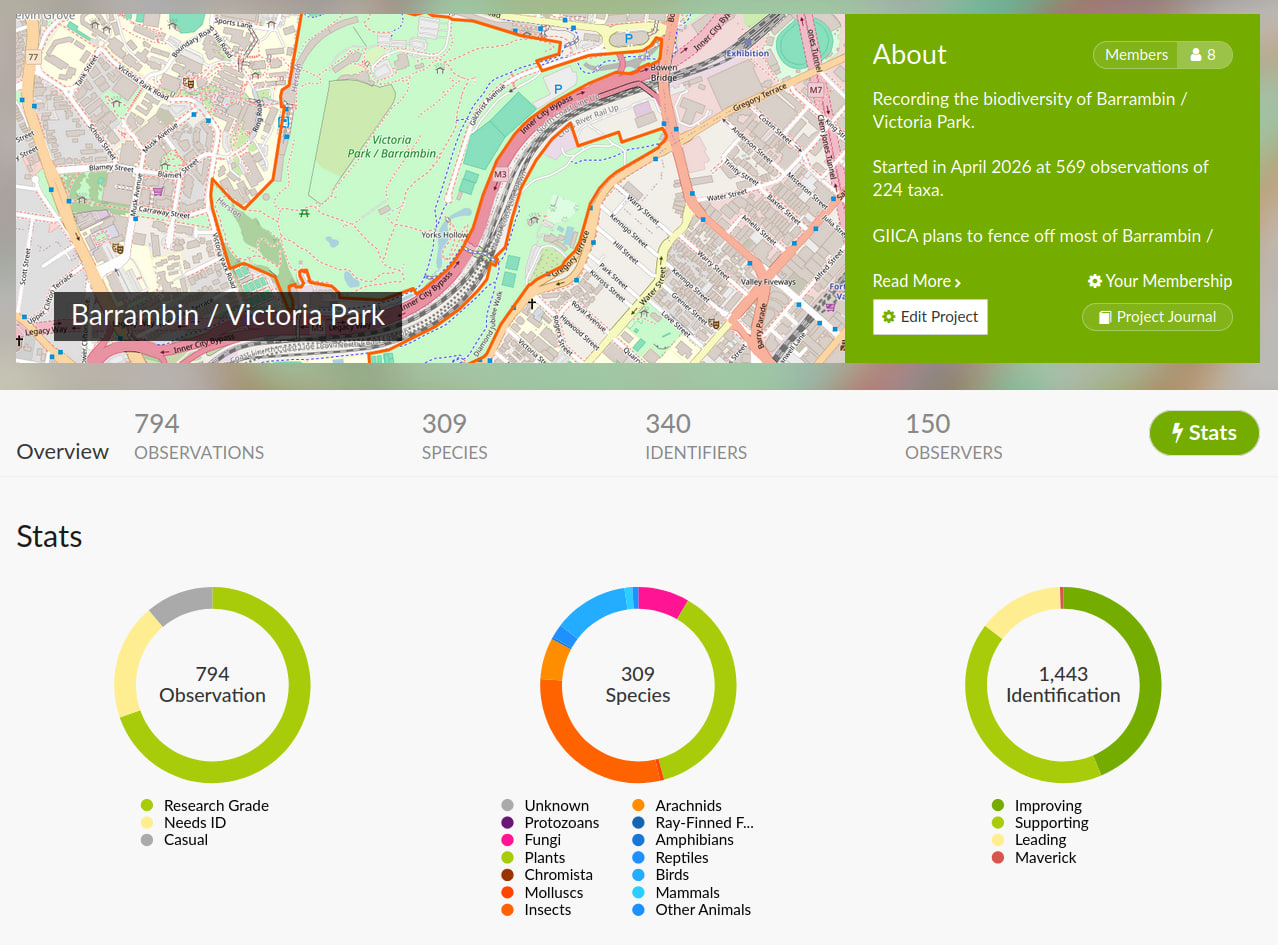
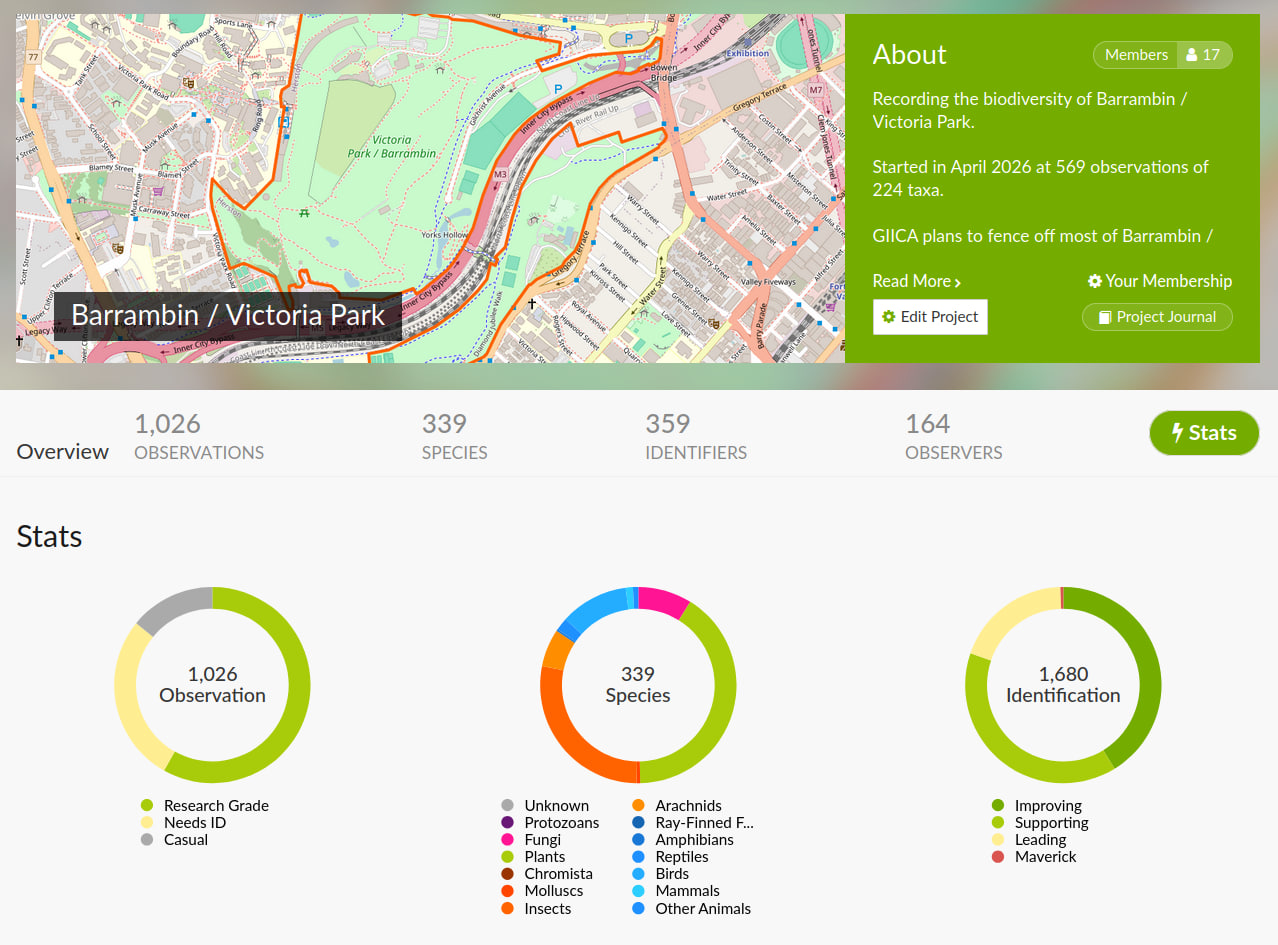
  • 794 to 1026 observations (+232)
  • 309 to 339 species (+30)
  • 1443 to 1680 identifications (+237)
  • 150 to 164 observers (+14)
  • 8 to 17 project members (+9)

Statistics on project page, with baseline numbers as in list above.

Project stats before the Bioblitz…

Statistics on project page, with updated numbers as in list above.

…and after.

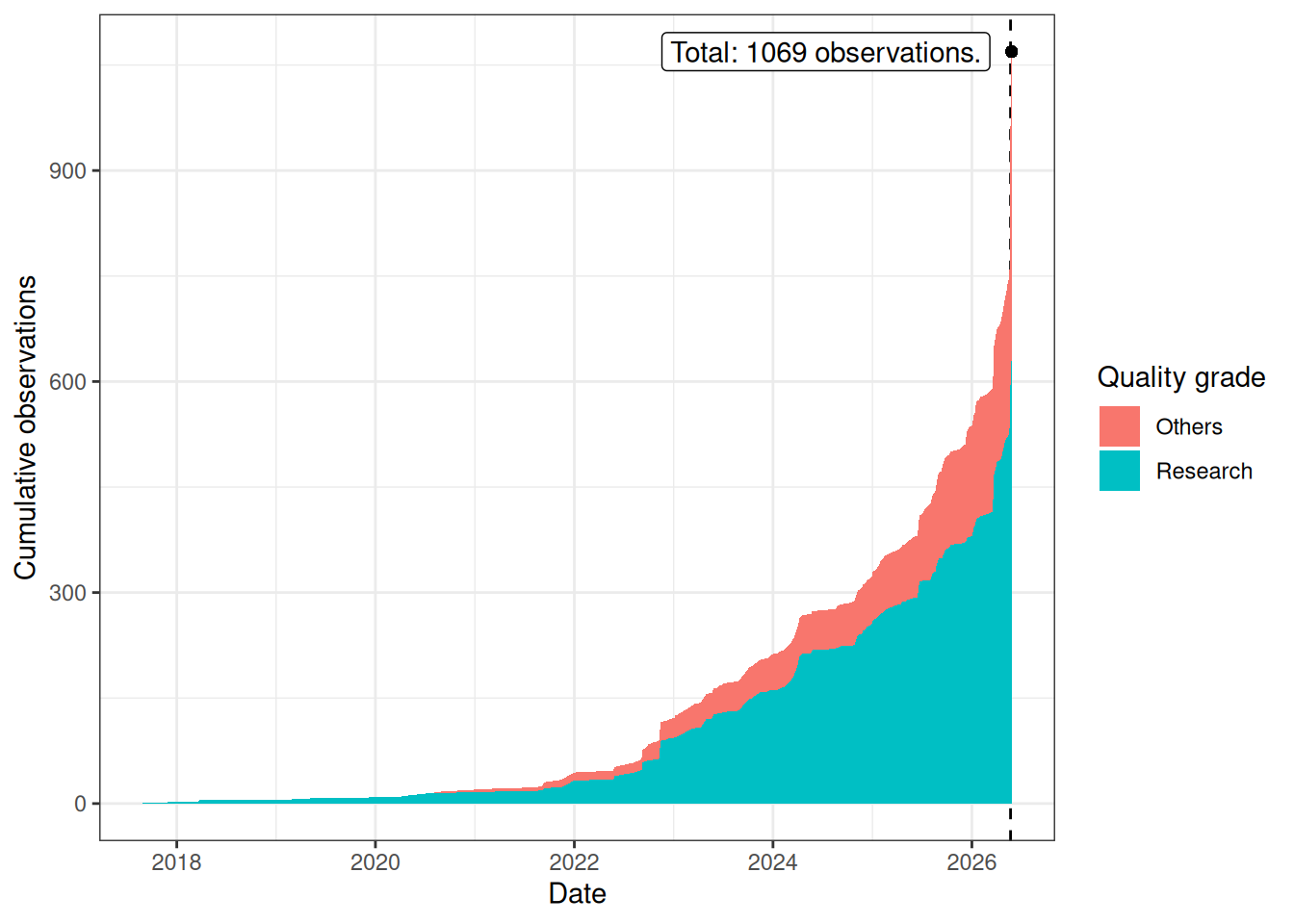
But the effort didn’t stop on the 23rd of May: at the time of writing, there are 1069 observations in the project.

Show the code
barr_obs$created_at <- as.Date(barr_obs$created_at)
library(dplyr)
cumulative <- barr_obs |> 
    mutate(rg = quality_grade == "research") |> 
    count(created_at, rg) |> 
    arrange(created_at) |> 
    group_by(rg) |> 
    mutate(cumulative_obs = cumsum(n)) |> 
    ungroup()
library(ggplot2)
theme_set(theme_bw())
ggplot(cumulative, aes(x = created_at, y = cumulative_obs, fill = rg)) +
    geom_vline(
    xintercept = as.Date("2026-05-23"),
    linetype = "dashed"
    ) +
    geom_area() +
    geom_point(x = max(barr_obs$created_at), y = nrow(barr_obs), inherit.aes = FALSE) +
    annotate("label", x = max(barr_obs$created_at) - 80, y = nrow(barr_obs),
    label = paste("Total:", nrow(barr_obs), "observations."), hjust = "right") +
    scale_fill_discrete(labels = c("Others", "Research")) +
    labs(
        x = "Date",
        y = "Cumulative observations",
        fill = "Quality grade")

Line graph showing a somewhat exponential increase in cumulative observations between 2018 and early 2026.

Cumulative observations in project area. The dashed line denotes when the bioblitz occurred.

So what new species were added recently? Looking at observations that have a species-level ID, and including observations recorded during and after the Bioblitz, we added 45 to the list:

Show the code
library(stringr)
species <- barr_obs |> 
    filter(taxon.rank == "species") |> 
    select(created_at, taxon.common_name.name, taxon.name, taxon.id) |> 
    # mark species that were seen after cutoff date but not before
    mutate(
        before = created_at < "2026-05-22",
        after = created_at >= "2026-05-22") |> 
    group_by(taxon.id) |> 
    mutate(only_after = !any(before) & any(after)) |> 
    ungroup()
# only keep the new ones, one row per species
new_species <- species |> 
    filter(only_after) |> 
    select(taxon.name, taxon.common_name.name, taxon.id) |> 
    unique() |> 
    # tidy up
    rename(
        scientific.name = taxon.name,
        common.name = taxon.common_name.name
        ) |> 
    mutate(common.name = str_to_sentence(common.name)) |> 
    arrange(scientific.name) |> 
    # construct link to iNat taxon
    mutate(taxon.id = paste0(
        "<a href='https://www.inaturalist.org/taxa/",
        taxon.id,
        "'>",
        taxon.id,
        "</a>"))
# print table
library(gt)
new_species |> 
    tibble::rowid_to_column() |> 
    gt(rowname_col = "rowid") |> 
    fmt_markdown(taxon.id) # ro render HTML
Table 1: Species observed since the Bioblitz but not before. Note that not all identifications have necessarily reached a consensus.
scientific.name common.name taxon.id
1 Albizia lebbeck Lebbeck 60832
2 Angophora subvelutina Broad-leaved apple 531489
3 Araucaria bidwillii Bunya pine 136231
4 Austromyrtus dulcis Midgen berry 429695
5 Banksia integrifolia Coastal banksia 244884
6 Brachychiton australis Broad-leaved bottletree 135372
7 Buckinghamia celsissima Ivory curl tree 411170
8 Calochlaena dubia Common ground fern 323953
9 Camponotus consobrinus Banded sugar ant 201978
10 Chlorophyllum rhacodes Shaggy parasol 56535
11 Codiaeum variegatum Variegated croton 127387
12 Corymbia henryi Large-leaved spotted gum 1023768
13 Corymbia intermedia Pink bloodwood 334817
14 Delonix regia Flamboyant 62839
15 Dianella caerulea Blue flax-lily 53680
16 Dodonaea triquetra Common hop bush 83633
17 Elaeocarpus grandis Blue quandong 369964
18 Erythrina lysistemon Common coral tree 119673
19 Erythrina vespertilio Bat's wing coral tree 369714
20 Eucalyptus carnea Broad-leaved white mahogany 538030
21 Eucalyptus cinerea Argyle apple 162748
22 Eucalyptus cloeziana Gympie messmate 1074794
23 Eucalyptus fibrosa Red ironbark 323762
24 Eucalyptus melanophloia NA 323757
25 Eucalyptus propinqua Small-fruited grey gum 334073
26 Eucalyptus punctata Grey gum 401758
27 Euphorbia hirta Asthma plant 131560
28 Eustrephus latifolius Wombat berry 334785
29 Ficus rubiginosa Port jackson fig 199385
30 Flindersia schottiana Cudgerie 192451
31 Fomitiporia robusta Robust bracket 485958
32 Grevillea robusta Silk oak 77302
33 Harpullia pendula Black tulip 369494
34 Heteropoda jugulans Jungle huntsman spider 369020
35 Lophostemon confertus Brush box 135363
36 Macadamia integrifolia Macadamia tree 287245
37 Melaleuca bracteata Black tea-tree 346356
38 Melaleuca thymifolia Thyme honey-myrtle 446704
39 Phoenix roebelenii Pygmy date palm 204744
40 Polyrhachis aurea NA 964525
41 Polyrhachis daemeli Daemel's spiny ant 201995
42 Pteropus poliocephalus Grey-headed flying-fox 40905
43 Rhytidoponera metallica Green-head ant 201975
44 Stenocarpus sinuatus Firewheel tree 83360
45 Tetragonula carbonaria Charcoal stingless bee 475518

Keep in mind that the newly-spotted species listed above are not necessarily all confirmed with several identifications. Here are some other places to explore what has been recorded at Barrambin:

More biodiversity data on the ALA

For a more exhaustive list of species recorded at Barrambin, the Atlas of Living Australia (ALA) collates observations from various sources – including the “Research Grade” observations from iNaturalist. For the same area used in our Barrambin project, at the time of writing, the ALA lists 497 taxa, including 21 “threatened species”.

TipALA Area Report

Download the ALA area report from the Internet Archive (PDF generated on 2026-05-28).

You can create your own up-to-date report and explore the data by heading to the ALA’s Spatial Portal, importing the area’s KML, and selecting “Tools - Area Report”.

Remember: by contributing more observations to the project, and identifying existing observations, we can continue building up a more accurate and exhaustive record of biodiversity at Barrambin, which eventually feeds into authoritative databases like the ALA.

Protecting Barrambin

Here are other ways you can continue protecting Barrambin: