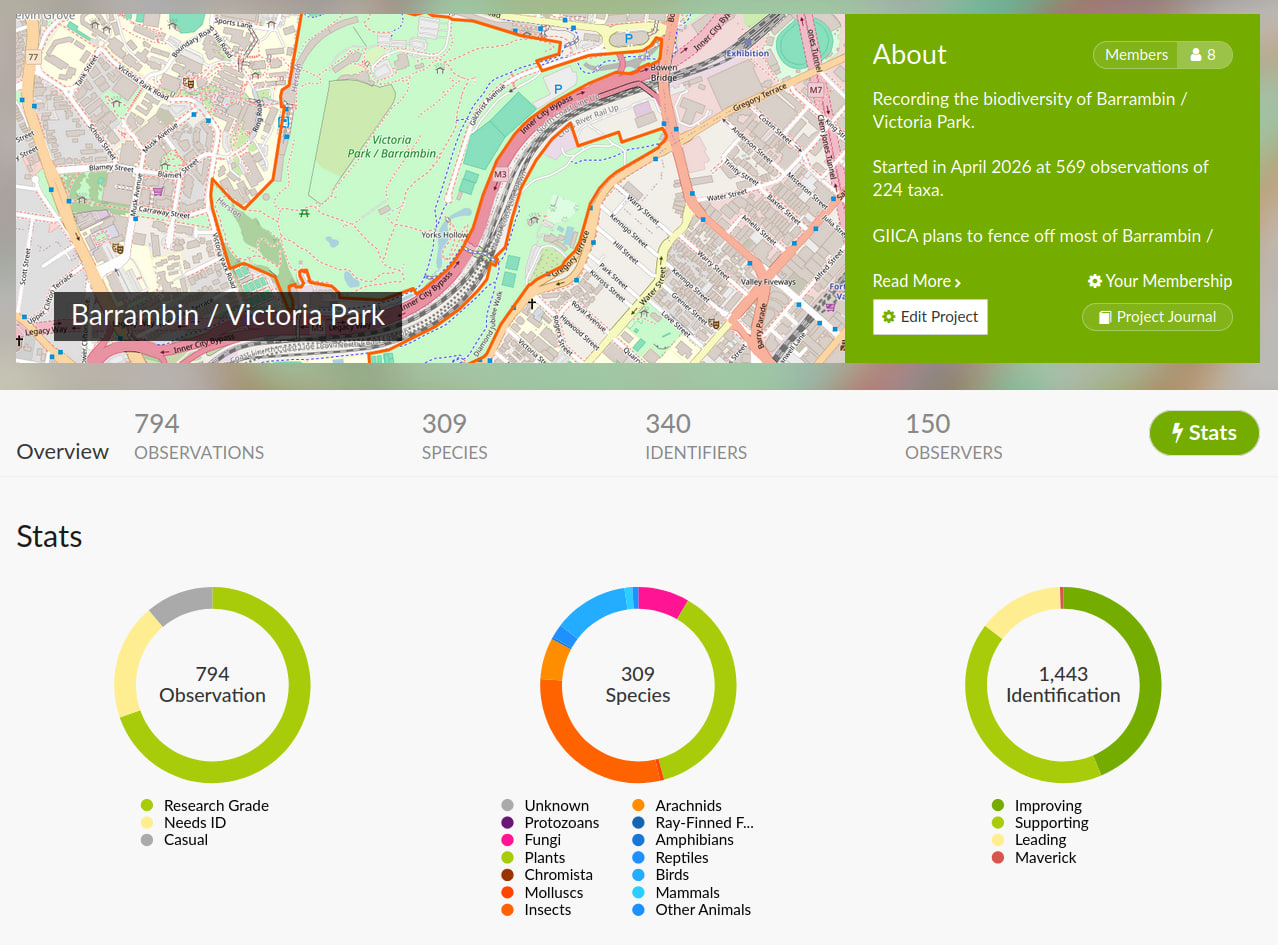
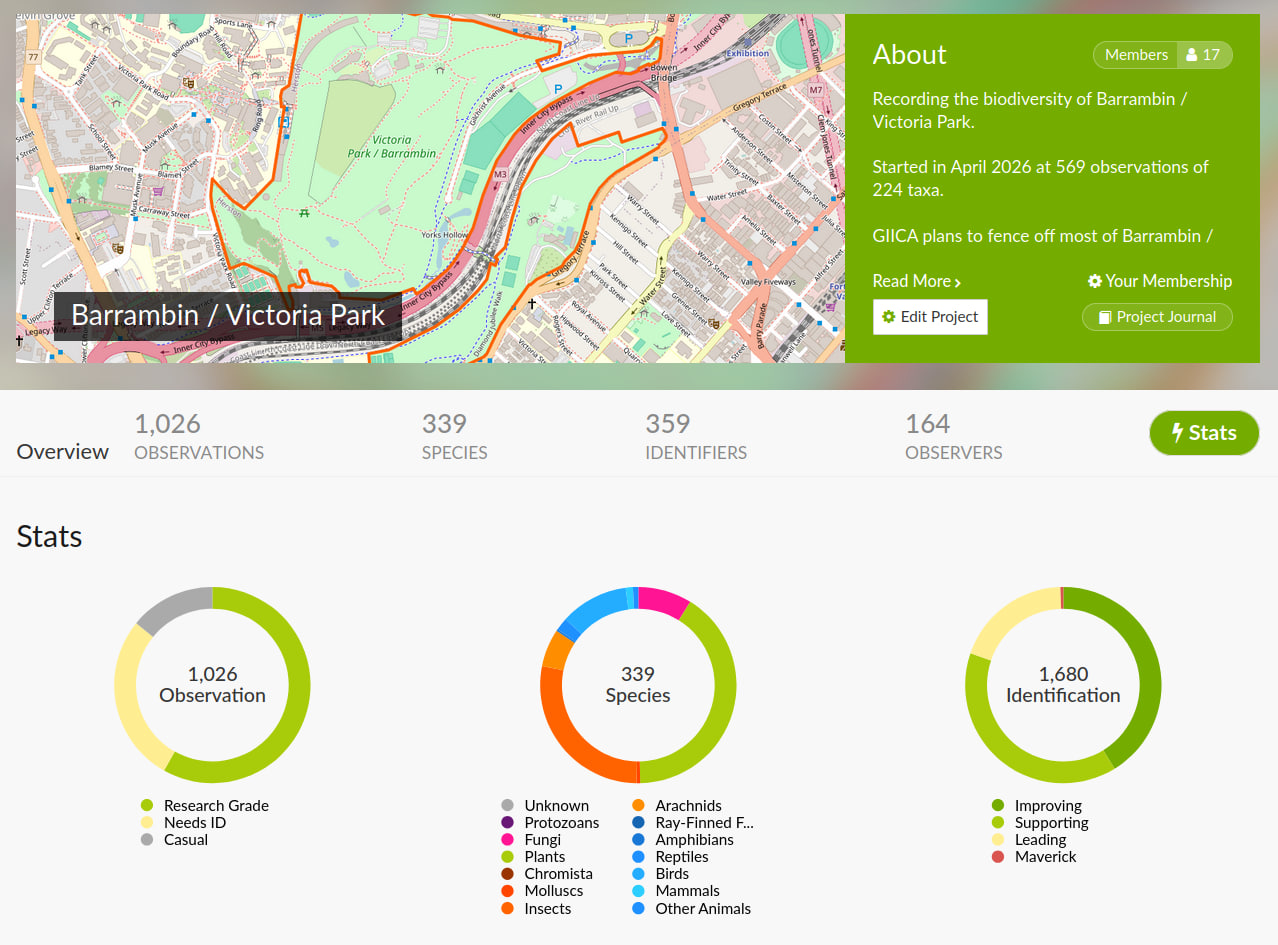
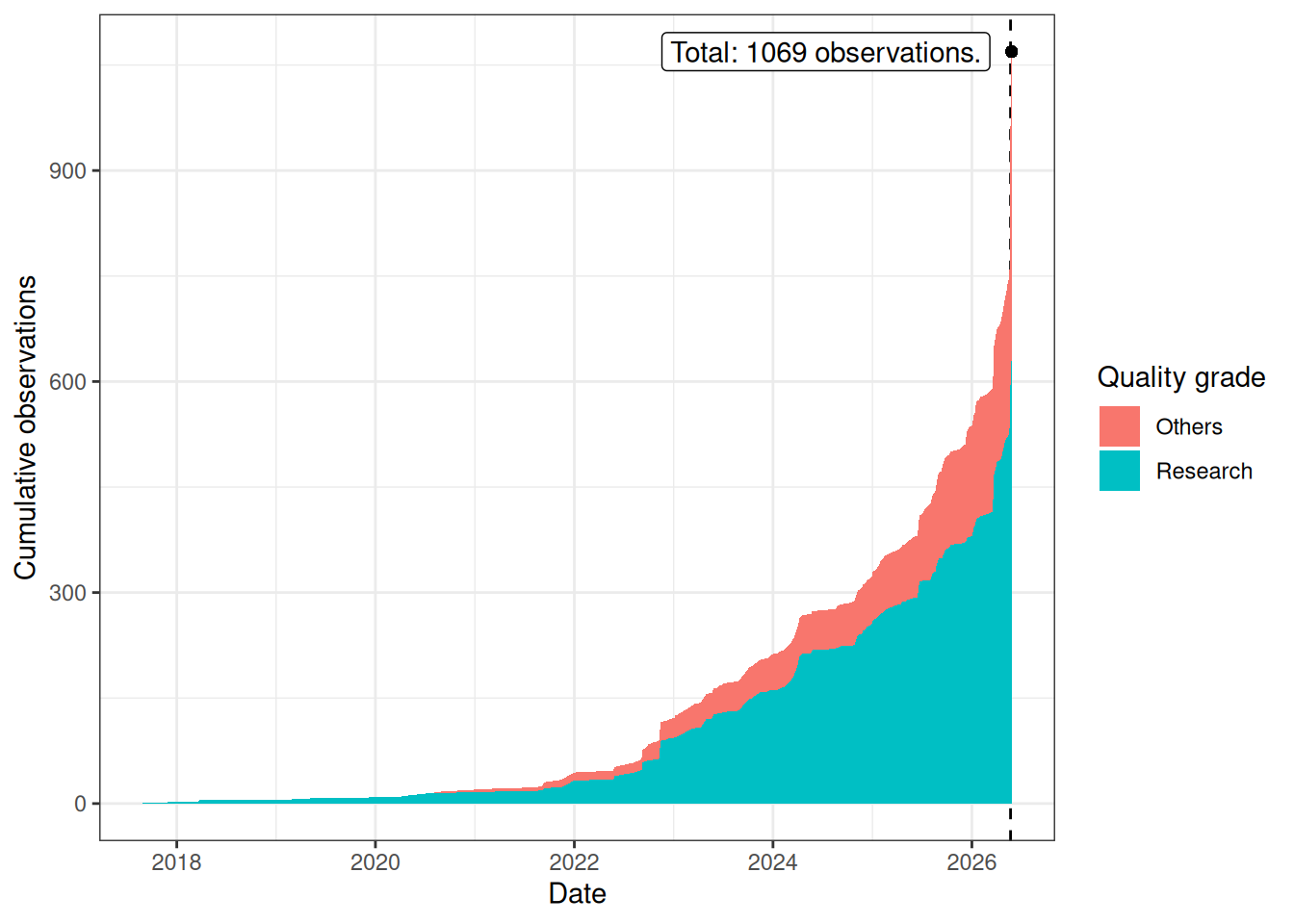
Cumulative observations in project area. The dashed line denotes when the bioblitz occurred.
So what new species were added recently? Looking at observations that have a species-level ID, and including observations recorded during and after the Bioblitz, we added 45 to the list:
Show the code
library(stringr)species <- barr_obs |>filter(taxon.rank =="species") |>select(created_at, taxon.common_name.name, taxon.name, taxon.id) |># mark species that were seen after cutoff date but not beforemutate(before = created_at <"2026-05-22",after = created_at >="2026-05-22") |>group_by(taxon.id) |>mutate(only_after =!any(before) &any(after)) |>ungroup()# only keep the new ones, one row per speciesnew_species <- species |>filter(only_after) |>select(taxon.name, taxon.common_name.name, taxon.id) |>unique() |># tidy uprename(scientific.name = taxon.name,common.name = taxon.common_name.name ) |>mutate(common.name =str_to_sentence(common.name)) |>arrange(scientific.name) |># construct link to iNat taxonmutate(taxon.id =paste0("<a href='https://www.inaturalist.org/taxa/", taxon.id,"'>", taxon.id,"</a>"))# print tablelibrary(gt)new_species |> tibble::rowid_to_column() |>gt(rowname_col ="rowid") |>fmt_markdown(taxon.id) # ro render HTML
Table 1: Species observed since the Bioblitz but not before. Note that not all identifications have necessarily reached a consensus.
Keep in mind that the newly-spotted species listed above are not necessarily all confirmed with several identifications. Here are some other places to explore what has been recorded at Barrambin:
The project’s ‘Identify’ page, on which you can help refine the data by adding your own identifications
More biodiversity data on the ALA
For a more exhaustive list of species recorded at Barrambin, the Atlas of Living Australia (ALA) collates observations from various sources – including the “Research Grade” observations from iNaturalist. For the same area used in our Barrambin project, at the time of writing, the ALA lists 497 taxa, including 21 “threatened species”.
You can create your own up-to-date report and explore the data by heading to the ALA’s Spatial Portal, importing the area’s KML, and selecting “Tools - Area Report”.
Remember: by contributing more observations to the project, and identifying existing observations, we can continue building up a more accurate and exhaustive record of biodiversity at Barrambin, which eventually feeds into authoritative databases like the ALA.
Protecting Barrambin
Here are other ways you can continue protecting Barrambin:
Sign the community submission to support the Section 10 Applications, before 5 pm, 29th of May